
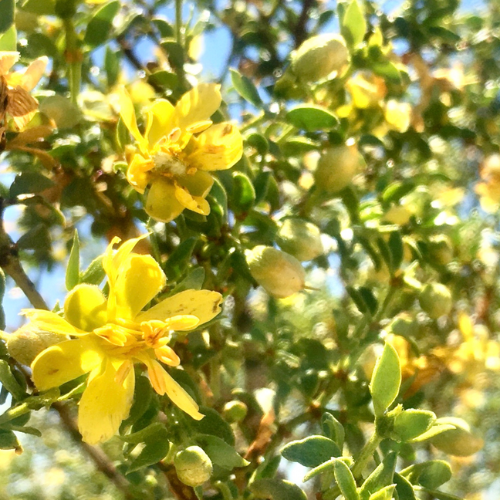
Larrea Tridentata (common names: Chaparral, Gobernadora, Hediondilla, Creosote Bush) is a safe and effective antimicrobial with a beneficial effect upon impaired liver metabolism. This leafy, reptilian, many-branched bush growing as a five to twelve foot tall monoculture in the American southwest, usually below 4,000 feet has rich, greasy, yellow green or waxy olive drab foliage with a distinctive smell.
Michael’s humor and deep understanding of biology and biochemistry colors all of his work. This “uses” section is excerpted from his book Medicinal Plants of the Desert and Canyon West:
MEDICINAL USES: “What Chaparral does comes from its ability to inhibit aerobic combustion in the mitochondria of cells.”
———
When applied to the skin as a tea, tincture, or salve, Chaparral slows down the rate of bacterial growth and kills it with its antimicrobial activity. This makes for a very useful first aid or long-term dressing for skin abrasions and injuries, for man or beast (not to sound sexists or species-ist).
Speaking practically, a tea made from Chaparral is nearly undrinkable. I would go so fat as to say that if you like its taste you may need professional counseling. This limits “patient compliance” and probable consumption to the tincture or capsule. Internally, it has a strong and beneficial effect upon impaired liver metabolism. If you have dry skin, brittle hair and nails, and cracks in the feet or hands, but have trouble digesting or even absorbing decent dietary oils, the regimen of Chaparral will help: 30 drops of the tincture or 2 capsules before retiring. Some clinical trials have shown that it aids individuals who also manufacture poor-quality blood lipids. In blood chemistry workups, this manifests as elevated LDLs (Low Density Lipids) and even (for the heavy drinker) VLDLs (Very Low Density Lipids). These transport fats really wreck the blood vessels, leading to arteriosclerosis and hardening of the arteries.”
———
OTHER USES: “Chaparral’s antioxidant abilities make it useful to prevent rancidity of vegetable oils…if you aren’t going to cook with them.” “Its ability to inhibit plant growth would seem to make it a perfect way to cut back your fast-growing junkers, like Bermuda Grass and the like, since the effects wash out when needed. If you figure our how to do it, and find out that it does or doesn’t work, please write and tell me.”
PART USED: Leafing Branches
PREPARATIONS:
- Tincture [1:5, 75% alcohol], 20-60 drops.
- Capsules,#00, 2-4 a day.
- Strong Decoction for topical use.
SUMMARY OF CLINICAL USES: First aid for skin abrasion and injuries, aides impaired liver metabolism.
Michael Moore compiled many resources from the eclectic era of medicine. One of these resources is from the oldest school of Pharmacy in the United States, founded in 1822, the Philadelphia College of Pharmacy. The College published a monthly journal for over a century. The new website continues to include the plant-specific excerpts from each issue, as curated by Michael Moore, of the American Journal of Pharmacy between 1881 and 1898.
On Larrea Tridentata, excerpted from from Volume 70, #5, May 1898 by Clement B. Lowe M.D.
LARREA MEXICANA.
BY CLEMENT B. LOWE, M.D.
Last year I received a small quantity of the above-named plant from W. C. Amsden, Ph.G., Class of 1890 of Garner, Iowa, saying that it had been sent by an uncle in California, and requesting information about it. Afterwards, at my request, Mr. Wm.H. Avery, of Los Angeles, California, sent on an ample supply of the drg.
———
The plant is a diffusely branched, densely leafy evergreen shrub, 4-10 feet high. The leaves and small twigs are thinly spread with a covering of a strongly-odorous resin that closely resembles in appearance ordinary shellac. To the abundance of this resinous matter the plant’s popular name of creosote bush is due, for in burning the green wood and leaves a pungent odor is detected and a dense smoke arises. The dead branches remain for many years without decomposing, and, although seldom more than 2 or 3 centimeters in diameter, they furnished the principal fuel to the Death Valley Expedition.
The functions of the resin seem to be to lessen transpiration, and thus to adapt the plant to the dry localities in which it grows. If this coating completely covered the leaves throughout the entire year, all evaporation would cease and the death of the plant would ensue, but it has been found that while the leaves in the winter time seem thoroughly varnished, the spring growth examined in June shows very little coating. As many of the herbarium specimens are gathered at this season of the year during the flowering period, they seldom show the resinous coating conspicuously, as it has not yet developed.
———
It is said that no animal of the country will eat the plant. It has various reputed properties. Miners say that a strong decoction will clean amalgam. It is reported that the Indians make a glue from it, with which they fasten the heads of the arrows to the shafts.
———
Mr. Avery says “that people living in the desert ascribe wonderful properties to it for curing external ailments, as galls and bruises on horses and mules. Pedestrians who become footsore by walking on hot sand claim to have been quickly cured by soaking the soles of their feet in a decoction of this herb.”