
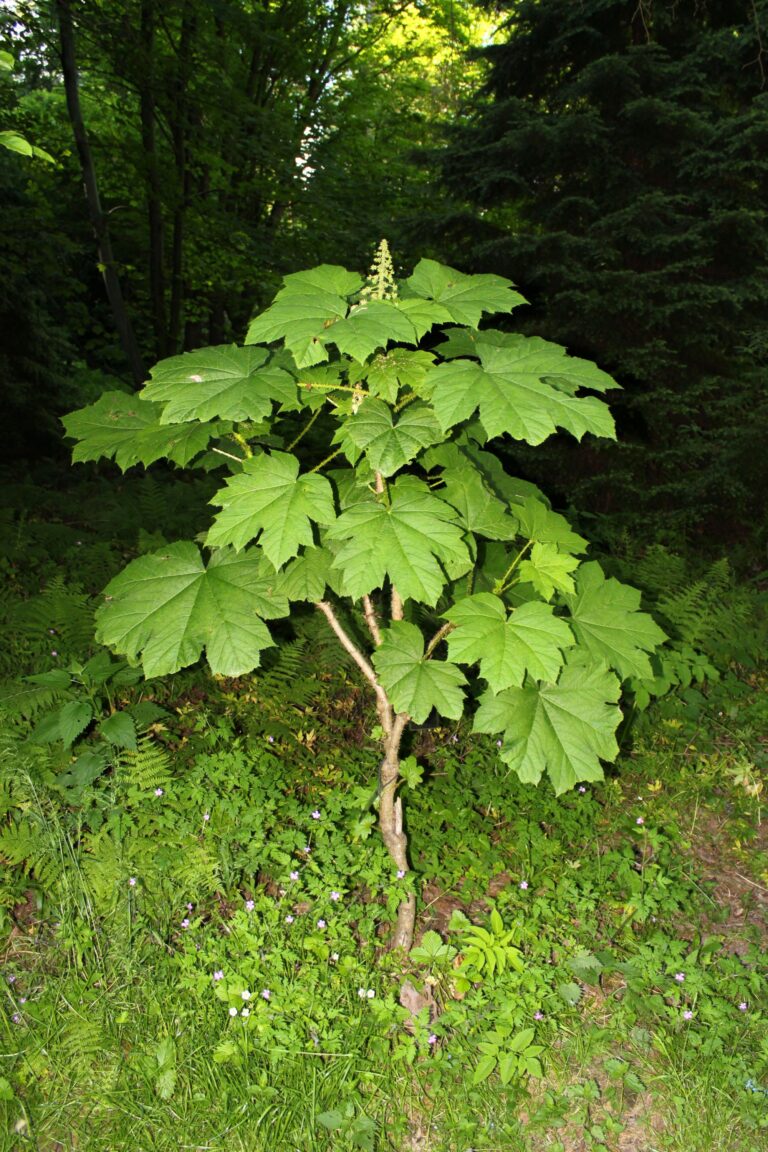
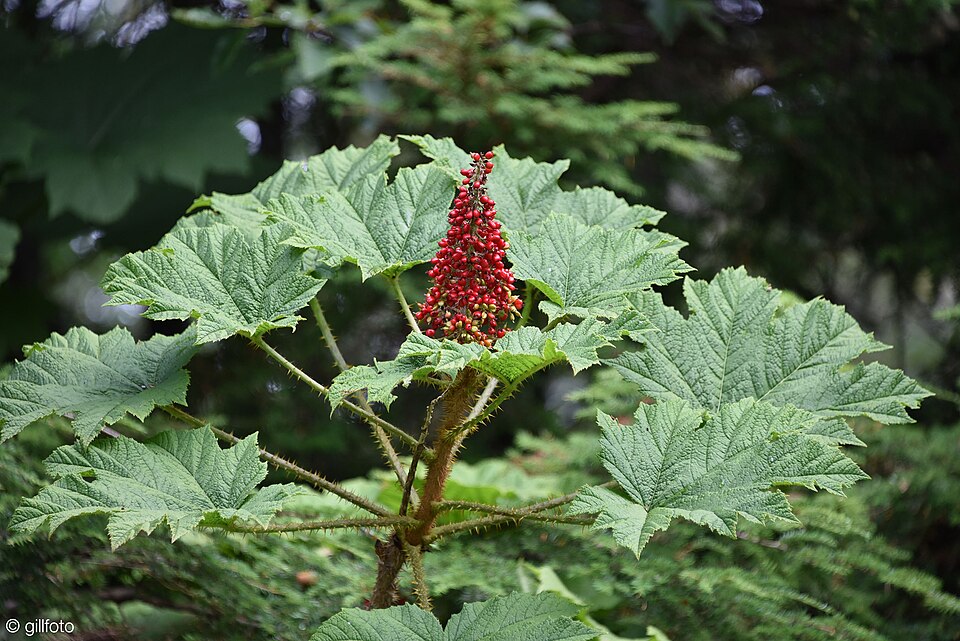
Oplopanax horridus (common names: Devil’s Club) thrives in the dark, cool cedar and hemlock forests of North America’s pacific northwest. This unmistakable plant with large, spiny umbrella leaves that sit atop thick, spiny 3 to 10 foot tall stems, usually grows from spreading rootstocks on steep, wet slopes. As the plant grows, the stems lie down and root making a thick mass. Those who work in these forests are familiar with how, when stepping near a patch, a large, springy stick covered in spines will often swing wildly at just about about eye level. Wear gloves when harvesting. The whole plant has a sweetly aromatic, balsamic scent.
Oplopanax is one of the apoptogenic herbs that Michael Moore explores in depth in his online video Clinical Herbalist course from 2006, available free on the new SWSBM website. The whole of lesson seven of the Herbal Therapeutics and Constitutional Evaluation lectures is dedicated to adaptogens. Michael explores Oplopanax and the physiology of its effects on humans in depth in Lesson 7.8 Oplopanax, Adaptogens 7.
Oplopanax, like many members of the Aralia family, including ginseng, is high in glycosides that decrease the extremes of hypothalamus and pituitary stress responses. Its main value as an adaptogen “is in modifying extremes of metabolic stress and adding a little reserve to offset the person’s internal cost of living” Michael Moore wrote in Medicinal Plants of the Pacific West, 1993. It is helpful for rheumatoid arthritis and other autoimmune disorders when taken regularly and works best outside of acute episodes. It has a long history of use by Native Americans for adult onset, insulin resistant diabetes. Michael writes, “In general, Devil’s Club seems to be an aid in times of body/mind stress and a means of increasing one’s feeling of well-being.”
Devil’s Club is also a strong, reliable and safe expectorant and respiratory stimulant.
From Michael’s Materia Medica:
Oplopanax Horridus, Devil’s Club
PART USED: Root and Rootbark
PREPARATIONS:
- Tincture [Fresh Root 1:2, Dry Rootbark, 1:5, 60% alcohol] 10-40 drops.
- Cold Infusion, 1-3 ounces, all forms to 3X a day.
CONTRAINDICATIONS: none